A practical guide to checking operators, understanding baccarat play and weighing table features, stakes and bonus terms.
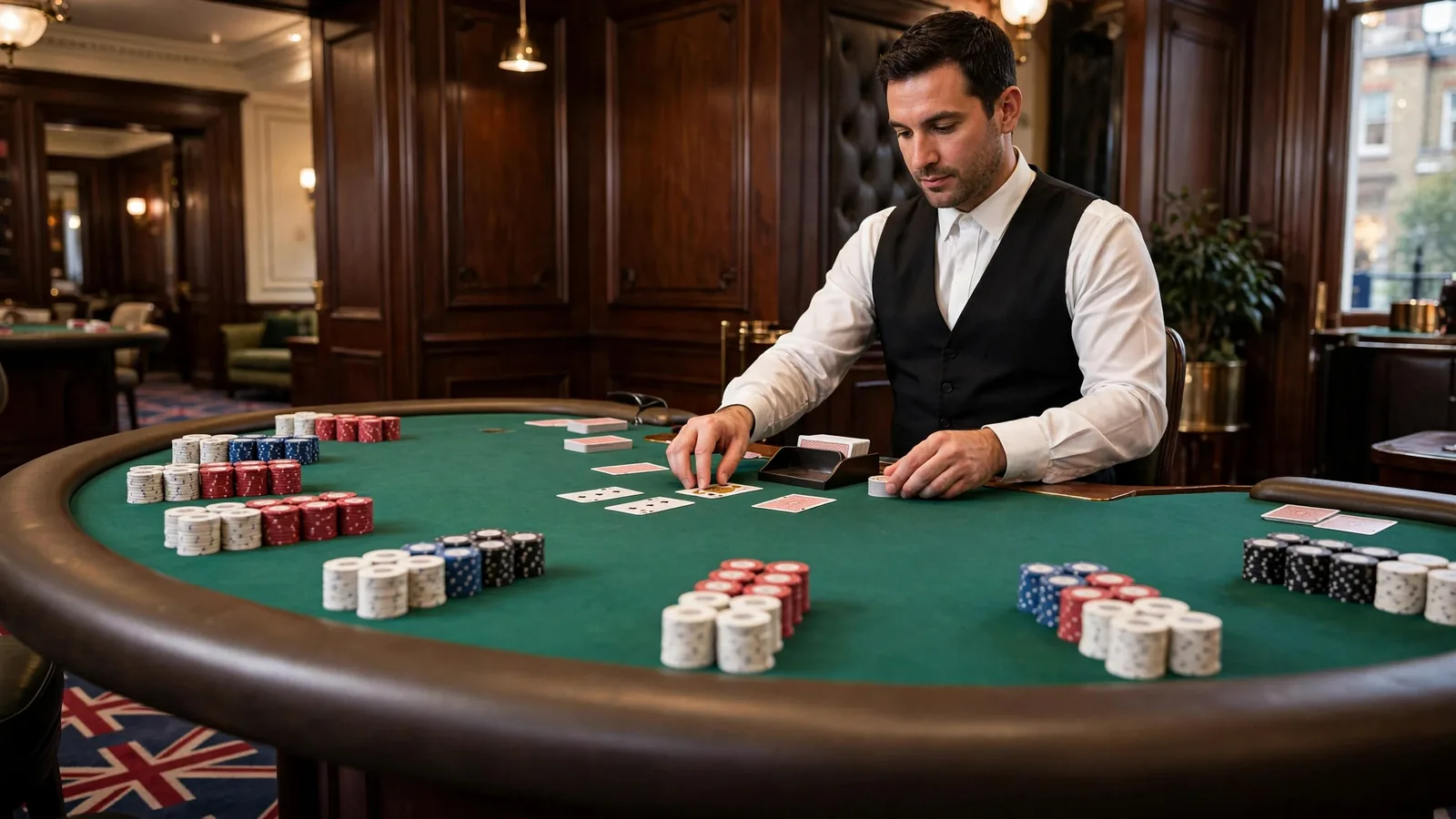
A polished homepage can make a baccarat casino look reassuring before you have checked anything that matters. I have learned to slow down at that point. The first question is not whether the site looks impressive, but whether it is allowed to offer real-money gambling to people in the UK.
For play in Great Britain, a remote operator serving local customers must hold the relevant UK Gambling Commission licence. Live dealer casinos are legal here when the operator has that licence. A badge in the footer is a starting point, not proof by itself: check the operator’s name and licence details against the Commission’s public register. Make sure the company named there matches the one taking your account, rather than assuming that a familiar brand name tells you who runs the site.
That check is worth doing before you hand over personal or payment details. An operator based abroad still needs the appropriate UK licence to serve the British market. If you cannot establish who operates the site or find a matching licence, stop there. A glossy design, a live studio or a reassuring-sounding claim does not replace regulation.
When choosing a UK casino for live baccarat, it helps to check the practical details available before you play. The verdicts below stick to the information provided for each operator.
EvoSpin
EvoSpin has a stated payout speed of 1–3 business days. You can use that timing as one practical detail when considering it for live baccarat.
Revery Play
Revery Play has a stated payout speed of 1–3 business days. You can use that timing as one practical detail when considering it for live baccarat.
WinBeast
WinBeast has a stated payout speed of 1–3 business days. You can use that timing as one practical detail when considering it for live baccarat.
Amunbet
Amunbet has a stated payout speed of 1–3 business days. You can use that timing as one practical detail when considering it for live baccarat.
Britsino
Britsino has a stated payout speed of 1–3 business days. You can use that timing as one practical detail when considering it for live baccarat.
NightWin
NightWin has a stated payout speed of 1–3 business days. You can use that timing as one practical detail when considering it for live baccarat.
x3bet
x3bet has a stated payout speed of 1–3 business days. You can use that timing as one practical detail when considering it for live baccarat.
Jetsetspins
Jetsetspins has a stated payout speed of 1–3 business days. You can use that timing as one practical detail when considering it for live baccarat.
NightLuck
NightLuck has a stated payout speed of 1–3 business days. You can use that timing as one practical detail when considering it for live baccarat.
Dieselwin
Dieselwin has a stated payout speed of 1–3 business days. You can use that timing as one practical detail when considering it for live baccarat.
Read the account terms before signing up, not after a payment or a disagreement. Look for the rules on account access, identity checks, deposits and withdrawals, and what the operator may ask you to provide. The point is not to hunt for fine print as a hobby; it is to know what you are agreeing to while you still have an easy choice.
Expect the operator to verify your age before allowing you to deposit. Online gambling in the UK is for people aged 18 and over, and a legitimate site should have an age-check process. Be wary of a sign-up flow that seems to treat verification as an afterthought or makes the operator’s identity hard to find.
I also check whether the site explains how to contact support and where its safer-gambling tools and policies are. Those pages should be easy to locate, not buried behind a chain of vague links. Set a budget before you play and keep to it; signing up is not a reason to loosen a limit you set for yourself.
Read the payment conditions carefully, including any rules about funding an account and withdrawing money. In the UK, operators cannot accept credit-card payments for gambling, including credit-card funding routed through a money service business. They also cannot accept wallet payments where the wallet allows credit-card funds to be used for gambling. Do not try to work around those restrictions. Use a permitted payment method and check that its terms are clear.
A site can describe a payment option as quick or easy, but that wording does not tell you how it will work for your account. Check what the operator says about processing, verification and any conditions that apply. If the explanation is unclear, ask support before depositing rather than relying on a promotional line.
A page calling itself the “best” baccarat casino site has not established that it is suitable for you. That label may be advertising; it says nothing by itself about licensing, account terms or how the operator handles customers. I would rather spend a few minutes checking the company and its policies than trust a confident headline.
The same goes for a site that looks professional but leaves basic information hard to find. Take your time. If the licence cannot be confirmed, the operator is unclear, or the terms do not make sense, there is no need to register just to see what happens. You can close the page.
This is entertainment information, not gambling advice. Check the operator and its terms for yourself, and do not deposit money you cannot afford to lose.
A “best” badge looks decisive. It is not a decision. Rankings can put a polished offer or a prominent site near the top without telling you whether its live baccarat tables suit the way you actually play. I used to treat a confident label as a shortcut. It saved time right up until I found myself choosing on the wrong grounds.
Instead, compare the experience you would be signing up for. Start with the live-table format: does the pace feel manageable, and can you follow what is happening without rushing your decisions? Live games move more slowly than digital versions. That can feel more like sitting at a real table, but it also means a session takes a different rhythm. If you prefer quick rounds, the live format may not be your fit, whatever a ranking says.
Then look at the minimum stake shown for the specific table, not just a broad claim about the casino. Live games can have higher minimum bets than digital versions, and the amount can matter more than a headline rating if it leaves little room to play within your own budget. Check the table information before joining; do not assume every table on the same site has identical terms.
Connection matters too. A live stream needs a stable internet connection, so a smooth experience depends partly on your setup. If the picture or audio keeps breaking up, it is harder to follow the table and the pace can become frustrating. That is not a problem a promotional ranking can solve. I would rather know what the live format asks of me than be sold a vague promise of a “premium” experience.
Promotional language is easy to scan and hard to measure. Words such as “exclusive” or “top-rated” do not tell you what a table allows, what conditions apply, or whether the experience matches your preferences. Read the terms attached to the table and the offer separately. An attractive welcome message does not automatically make the underlying game a better choice.
Make a short comparison using details you can actually verify: the live pace, the displayed minimum stake, how clearly the table information is presented, and whether you can play comfortably with your connection. Add any relevant conditions to that check rather than mentally filing them under small print. If a term is unclear, pause and find the explanation before you commit.
This is also where “best baccarat casinos” becomes a less useful idea. There is no single label that can account for your budget, tolerance for a slower game, or preference for a live stream over a digital version. The best baccarat casino UK for one person may simply be the one whose table conditions and format suit them; another player may reasonably make a different choice. That is a fit, not a universal verdict.
I now treat rankings as prompts for further checking, not as proof. A list can help you notice options, but it cannot make the comparison for you. Check the details that affect your own session, and leave out anything you cannot confirm. If the table’s pace or minimum does not work for you, a glowing description does not change that.
Set your budget before you begin, and use it as a boundary rather than something to renegotiate mid-session. The point of comparing is not to find a site that promises a result. It is to avoid choosing on a slogan when the practical details are available to inspect. No magic pick.
The first thing to get straight is that a baccarat bet is about which hand will finish nearer to nine, not about choosing cards or deciding how either hand should be played. You can back the Player hand, the Banker hand or a Tie. “Player” and “Banker” are the names of the two hands; they are not instructions to take a turn. That distinction cleared up a lot for me.
Once bets are placed, two cards are dealt to each hand. Their values are added to make a total, and the aim is to compare those totals against nine. A hand does not need to reach nine exactly to win: it needs to finish closer to nine than the other hand. If the totals match, the result is a tie.
The scoring has a small twist. When a hand’s total goes past nine, you count only its final digit. So the total wraps back around rather than continuing upwards in the way you might expect from ordinary addition. That is the route to nine: the important figure is the hand’s baccarat total after this adjustment, not the unreduced sum of its cards.
It is worth keeping “card values” and “hand total” separate in your head. Add the values of the cards, apply the last-digit rule if the sum exceeds nine, then compare the resulting totals. The hand with the higher baccarat total is closer to nine. If both totals are equal, neither side is closer and the result is a tie.
I used to focus on the cards themselves and lose track of what the total meant. Better to follow the total. Less fuss.
After the opening deal, a third card may be drawn to the Player hand, the Banker hand or both. It is not a choice made by the person who backed that hand. Whether another card is dealt depends on the totals already showing and the specific rules being used at the table.
That means the first two cards do not always settle the hand. The dealer follows the game’s drawing rules, and the final comparison is made only once any required third card has been dealt. Since the decision depends on the totals and the game rules, it is not safe to assume that one hand always draws first, or that a hand will always stand on the same opening total across every version.
For a new player, the practical point is simple: you place a bet on an outcome, then watch the deal and the rule-driven draw. You do not call for a card, and you do not need to work out a strategy for taking one. The table’s rules determine whether the extra card is dealt.
Scoring Process
Add values
Add the values of the cards dealt to the hand.
Apply last-digit rule
If the sum exceeds nine, count only the final digit to find the baccarat total.
Compare totals
Compare the resulting totals; the hand closer to nine wins.
A Player bet wins if the Player hand finishes nearer to nine. A Banker bet wins if the Banker hand finishes nearer. A Tie bet is for matching final totals. These are bets on the result, not on which hand receives more cards or which one looks stronger after the opening deal.
If you are following a live baccarat table, try tracking the totals rather than guessing from the card faces. First compare each hand after the opening deal; if a third card is required, wait for it and then compare the final totals. The same scoring idea applies whether you are considering a baccarat casino or playing online: the labels identify the outcomes, while the route to nine decides which hand is closer.
It is a compact game once that clicks. Bet on the hand or tie you think will be the outcome, let the dealing rules run, and judge the final totals. No card-picking required.
Live baccarat feels different from clicking through a digital game because the cards are dealt by a human dealer on a real-time studio stream. You watch the table unfold, then use the on-screen controls to take part. The dealer and the other players give the game a more social, casino-like atmosphere, even though you are still playing through a screen.
I used to assume that “live” meant more control. It does not. You can follow the action as it happens, but the stream does not give you a say in how the cards are dealt. The difference is the experience: you can see a person running the table rather than watching an entirely computer-generated presentation. That can make a session feel more involving, but it does not change the underlying game.
The interface matters because it is where you follow the round and make your choices. Take a moment to see what is on screen before joining in; rushing because a table is already moving is an easy way to feel behind. I have done that, clicked through without getting comfortable, and spent the next hand trying to work out what I had missed. Not a clever start.
Live play has a steadier rhythm than a digital version, since the dealer has to run the table in real time. That pause is part of the format, not a sign that something is wrong. If you prefer a quick sequence of hands, the wait may feel slow. If you like seeing the game handled in front of you, the pace can be part of the appeal.
A stable internet connection also matters: a stream that freezes or falls behind makes it harder to follow what is happening. Before you begin, set a budget and keep to it; the more immersive presentation can make it easy to lose track of the fact that this is still gambling. This is entertainment, not gambling advice.
Live blackjack offers a useful comparison because the dealer-led format is familiar, but the game itself asks you to think differently. Its dealer is streamed in real time too, and deals physical cards from a standard deck. You can see and interact with the dealer, rather than relying only on a simulated table. Some live blackjack games also offer chat, side bets or Bet Behind, though those features depend on the table.
The aim in blackjack is to beat the dealer with a hand worth 21 points or less. That gives you a clear target to keep in mind as the cards are dealt. Baccarat’s live presentation can feel similarly immediate, but you are following a different game and should not carry blackjack assumptions across. The shared part is the human dealer and the live pace; the decisions and objective are not interchangeable.
That is what blackjack gets right as a comparison: it makes the live format easy to picture. You see physical cards dealt, watch the dealer, and follow the action as it happens. Baccarat brings the same human presence to its own table, but it is worth approaching on its own terms rather than treating it as blackjack with different cards.
If you want to play baccarat online, give yourself time to settle into the stream before making decisions. The live table is less like tapping through a quick app game and more like joining a dealer-led session from your screen. That can be the draw. Just do not mistake atmosphere for an edge.
When you play baccarat for cash, the number printed beside a bet is only part of the cost. I used to look at the Banker option as if its payout told the whole story. It doesn’t: when a Banker hand wins, the casino typically takes a 5% commission on that winning bet. Check how the table applies that charge before you stake anything, and make sure you understand what amount you would actually receive.
That commission is tied to the Banker result, not a general fee on every hand. A losing Banker bet does not become cheaper because the table charges commission on wins; your stake is still at risk. And a winning Player bet is handled under its own listed payout. The useful comparison is the table’s full paytable, not a single headline figure or a quick glance at the felt.
On a real-money baccarat table, read the rules and paytable before you place a bet. Look for the payout attached to each available outcome and check whether the commission is explained clearly. If the wording is hard to follow, pause rather than treating the default as obvious. Tables can present their terms differently, and the rules shown for the game you are about to join are the ones that matter.
Stakes and limits are just as practical. A table’s minimum tells you whether you can place a bet within the budget you have set; its maximum tells you where you cannot go beyond, even if a hand seems tempting. Those limits are not a sensible target. I have made the familiar mistake of treating the amount available as an amount I should use. Bad idea. Decide what you are prepared to spend before opening the table, and stop when you reach it rather than adding money to recover a loss.
For baccarat online with real money, also check whether the rules change between tables. A familiar game name does not tell you every payout detail, and a live table’s presentation can make it easy to click before reading. Take a moment to find the table information, review its paytable and confirm the Banker commission. If you cannot tell how a winning bet is settled, choose not to stake until the terms make sense.
This is not a way to make the game predictable. The commission is a cost to account for, not a reason to favour one outcome or raise your stake. A real-money baccarat casino may make the action look simple, but your decision still involves money that can be lost. Keep the stake within your set budget, leave credit cards out of gambling payments, and do not chase losses or winnings past your limits.
The point is not to calculate every hand in your head. It is to know what the table will pay, what it will deduct from a Banker win, and what stake range you are agreeing to use before play begins. If those details are clear, you can make an informed choice about whether that table suits your budget. If they are not, there is no need to rush.
A table can look polished and still be a poor fit for the way you want to play. I’ve learned not to treat a dramatic studio, a busy screen or a “top” label as a reason to sit down. The useful checks are less glamorous: read the table rules, look at the minimum stake, and decide whether the pace suits you before you commit.
Start with the rules shown for that table. Baccarat has familiar basics, but the dealing procedure can depend on the specific game rules, so don’t assume every table handles a hand identically. Read the rule panel and paytable before placing a bet. If the wording is unclear, or you can’t find the information, that’s a reason to pause rather than guess. A table you understand is worth more than one with flashy presentation.
Then check the minimum stake against the amount you have set aside. A low entry point can make it easier to keep each decision within your budget; a higher one may make the session feel pressured before it has properly begun. A specialist review has reported live baccarat and roulette tables starting at around 20p, while blackjack tables often have higher starting limits. Treat that as one reported example, not a standing market standard: limits can vary, so check the figure displayed at the table itself.
The pace matters too. Live games move more slowly than digital versions because you’re following a real-time studio game and betting through an on-screen interface. I used to read a slower round as a chance to rethink every decision. Mostly, it gave me more time to second-guess myself. If you prefer rapid play, the wait between hands may grate; if you want time to follow the table, it may feel more comfortable. Either way, don’t let a quiet gap tempt you to raise your stake just to make the session feel more exciting.
A few practical baccarat casino tips are simple enough to use before you join: check the table’s minimum, read its rules and paytable, and set a spending limit before play. If the minimum doesn’t fit that limit, choose another table or leave it for another time. There’s no prize for making a table fit your budget by stretching the budget.
The best table for you isn’t necessarily the one with the grandest studio or the most confident description. It’s the one whose rules you can follow, whose minimum suits your plan and whose rhythm you can accept without chasing a change of pace. Take a moment to check. Then decide calmly.
Standard baccarat is the useful reference point when a casino lobby groups several games under a similar-looking label. The familiar version asks you to back the Player hand, the Banker hand or a Tie. The names can make it sound as though you are choosing a side in a contest, but you are betting on which hand will finish closer to nine. That is the basic shape of the game; the nearby titles can use cards or dice while asking you to make a very different decision.
I find it helps to ignore the lobby category for a moment and look at what actually determines the result. In baccarat, the hands and their final totals matter. With Andar Bahar, the central question is about where a matching card appears. With Bac Bo, the scores come from dice. Same broad casino neighbourhood. Different game underneath.
Andar Bahar is a card game built around a Joker card. The aim is to guess whether the card that matches it will show up first on the Andar side or the Bahar side. So, unlike standard baccarat, you are not picking which of two hands will end closer to nine. You are choosing which side will produce the matching card first.
That one change is enough to make the games feel unrelated once play starts. Baccarat centres on comparing hand outcomes; Andar Bahar centres on the order in which a particular card appears. If you are browsing for a baccarat casino game and click through to Andar Bahar because it sits nearby, take a moment to read the screen. Familiar cards do not mean familiar rules.
Bac Bo moves further from baccarat. Each hand is scored by adding the values of two dice, and the higher total wins. There are no baccarat hands to follow: the result comes from the dice scores instead.
That gives you a straightforward way to tell the games apart without getting caught by their shared casino setting. Baccarat asks you to consider the Player and Banker outcomes, with a Tie also available. Bac Bo compares the totals from two dice. The visual presentation may feel lively, but the underlying choice is not the same.
Comparing hand outcomes to see which finishes closer to nine.
Guessing whether a matching card appears first on the Andar or Bahar side.
Comparing the totals of two dice to determine the winner.
I have learned not to treat “baccarat games” as a promise that every option follows one set of rules. A casino may place different live games close together, but proximity is not a rules guide. Read the game’s own instructions before staking anything, and check the table rules and paytable rather than relying on a familiar title or a quick glance at the interface.
If you want baccarat, choose the standard game deliberately; if you want to try Andar Bahar or Bac Bo, approach each as its own game. No system makes those outcomes predictable, and a past result does not tell you what comes next. Set a budget before you play and keep to it. This is entertainment, not gambling advice.
“Lightning” sounds like a promise of extra drama, but I wouldn’t treat the label as a clue to how a particular table works. Without clear rules for the version in front of you, don’t assume it changes the cards, the betting options or the way results are decided. Read the table information before playing; if it leaves something unclear, that uncertainty is a reason to pause, not a puzzle to solve with guesswork.
The basic baccarat idea is still straightforward: you choose whether the Player hand or the Banker hand will end nearer to nine, or whether the hands will tie. That gives you outcomes to bet on, not a way to know what comes next. A flashy name doesn’t turn chance into a system.
I’ve made the mistake of staring at a run of results and deciding it must be pointing somewhere. It felt like research. It was just me looking for a pattern after the fact. A tracker can organise previous outcomes, but a record of what has happened does not tell you what the next hand will do. The same goes for a streak, a sequence on screen or a hunch that one side is “due”.
That matters if you are choosing an online casino with baccarat. Check what the table actually explains rather than filling gaps with claims from a lobby label or a promotional description. If you cannot tell what a feature means, you cannot make a sound decision about it. Leave it alone until the rules are clear.
I also try not to let a losing run turn into a reason to raise stakes or keep playing. Set a budget before you start and stick to it; don’t chase losses or winnings. Baccarat is a game of betting on hand outcomes, not a method for beating the casino. The name may change. That part doesn’t.
This is entertainment, not gambling advice.
A live dealer Baccarat table is a studio stream, not an animated version of a card game. You watch a human dealer handle the game in real time, while your bets go through an on-screen interface. That mix is what gives it a more physical feel: you are following an actual table rather than waiting for a digital game to deal instantly.
I find the change of pace is the first thing to notice. Live games move more slowly than digital versions, because the action is being dealt and shown as it happens. That can make a session feel more involving, but it also means fewer hands in the same stretch of time. Don’t mistake the pauses for a chance to hurry your decisions. Take the time to follow the table and use the interface carefully.
On a desktop, the larger screen can make it easier to keep the dealer and betting controls in view together. On a phone, the same experience is more compact, so check that you can see what you need before placing a bet. The exact layout depends on the game interface; I wouldn’t assume every table handles a smaller screen in the same way.
The connection matters more than it does for a self-contained digital game. A stable internet connection is needed to follow the live stream and submit bets. If the picture stutters or the interface responds slowly, I’d rather stop and sort out the connection than make a rushed decision while unsure what is happening. No hand is worth that.
Live tables also have higher minimum bets than digital versions, so the more immersive format can come with a different cost of entry. Set a budget before you start and stick to it; the studio atmosphere can make play feel less like tapping through software, but it does not change the risk.
For me, the appeal is the human dealer and the sense of sharing a real-time table. The trade-off is a slower rhythm and a need to stay connected. Check the table and interface before playing, and remember this is entertainment, not gambling advice.
A baccarat casino bonus can look generous on the banner and turn out to be awkward at the table. I’ve learned not to treat the headline amount as money I can simply take to live baccarat. The terms decide whether the game counts towards the offer, and how much it counts.
A specialist review of UK promotions reports that some welcome offers are free spins for slots, which cannot be used at live tables. That does not tell you what a particular casino offers today; it is a reason to open the promotion terms before opting in. If you want a baccarat casino welcome bonus, check that baccarat is eligible rather than assuming the word “casino” covers every game.
Then look for wagering requirements and game weighting. Specialist reviews describe live games as sometimes contributing only a small share, with 10% given as an example. Baccarat may also count for less than the full amount towards wagering. In practice, that means play at the table might make much less progress through the requirement than the offer’s headline suggests. A deposit bonus is still an offer with conditions, not a shortcut around them.
I used to skim the banner and miss the details. Costly habit.
Read the terms for which games qualify, how their contribution is calculated, and any maximum bet limit while the bonus is active. Check whether the offer is a no-deposit promotion or requires a deposit, and whether the bonus balance has restrictions that matter to live play. “No deposit” describes how an offer is funded; it does not mean there are no conditions.
The same care applies if you are comparing a baccarat bonus in the UK with an online offer advertised for other games, or considering a Bitcoin baccarat casino. A payment method or a baccarat label does not tell you whether the promotion applies at a live table. Confirm the rules for that specific offer.
If the conditions make the bonus hard to use on the game you actually want, declining it may be simpler. Before opting in, check wagering requirements, game weighting and maximum bet limits. Set a budget and stick to it; don’t chase bonus progress by raising your stakes or playing beyond it. This is entertainment, not gambling advice.
Choose a UK-licensed operator and check its details on the UK Gambling Commission’s public register. Before signing up, review the account and payment terms, safer-gambling information, and the specific table’s pace and minimum stake; you’ll also need a stable internet connection.
You can find European, American and French roulette. American roulette has both 0 and 00, while European roulette has one 0; in French roulette, an even-money bet loses only half when the ball lands on 0.
Place your bet using the on-screen interface, then watch the dealer spin a physical wheel. You win if the ball lands on the number you selected.
The dealer does not always win. You aim to beat the dealer with a hand totalling 21 or less, although blackjack retains a house edge.
It varies by game and bet: in roulette, straight-up bets have a 2.9% house edge, while other bets have a 2.7% edge. In French roulette, an even-money bet loses only half when the ball lands on zero.