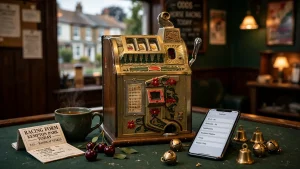
Cherries, lemons and bells echo physical fruit machines, but an online slot is software and its images do not reveal how it produces results.

The first thing I notice about an online fruit machine is how quickly its pictures feel familiar. Cherries, lemons, bells and bright symbols still do the work they did on a physical machine: they make the game recognisable before you have learnt anything about its layout. That visual link is why a digital slot can feel like a pub fruity even when it is running on a screen rather than standing in a room.
Online fruit-machine-style slots grew out of physical fruit machines, but the move was more than a change of location. A cabinet had its own presence: a screen, buttons, sound and a body you stood in front of. Online, the game is software. Its appearance can preserve the old visual language while its underlying operation relies on modern digital systems.
I used to treat the familiar symbols as if they told me what was happening behind the screen. They don’t. A cherry is a cherry, whether it appears on a cabinet or a phone, but the image alone says nothing about how the digital game produces its result. That distinction is easy to miss when the whole point of the design is to look instantly recognisable.
The key change is that online games use random number generators, or RNGs, to produce outcomes. Each outcome is generated independently. The old-fashioned look does not mean a digital game is simply reproducing a physical machine’s mechanism, nor does a run of symbols tell you what the next result will be. The surface may nod to an older kind of machine; the process underneath is digital.
That gap between appearance and operation is where I think the transition makes most sense. Designers can keep the cues people associate with fruit machines, then build a software game around them. The screen can look cheerful and familiar while the system determining results remains separate from the symbols’ nostalgic feel. Familiarity is a style choice, not a signal that the game behaves like a particular cabinet.
Moving online also changed what “being at the machine” means. There is no cabinet in front of you, and the game is presented through a screen rather than as an object in a pub or arcade. That may sound obvious, but it affects how the experience lands. On a physical machine, the setting is part of the encounter; online, the game has to create its own atmosphere through its images, movement and sound.
Some of that atmosphere is deliberately old-school. Fruit symbols and bold colours can bring back the feel of a traditional machine without copying every part of it. Other games use the same broad visual cues in a more contemporary presentation. The result is not one single digital version of the old fruit machine. It is a family of games that borrow from that history in different ways.
That is why I don’t take a vintage-looking screen as proof that a game is simple, predictable or mechanically old-fashioned. Nor do I assume that a polished digital presentation has left the fruit-machine heritage behind. The visual style and the system that generates outcomes are different layers. Once I separated them in my head, the games became easier to understand without reading too much into the artwork.
This blend helps explain the appeal of online fruit slots in the UK. Someone who recognises the fruit-machine imagery has an immediate point of reference, while the digital format can present it in ways a physical cabinet could not. But that does not make every game interchangeable. The shared heritage is a starting point, not a promise that all titles will look or behave alike.
I also find it useful to think of the transition as a change in what the player sees, rather than a straight line from one machine to its online copy. The old imagery survived because it carries meaning. The physical object did not have to survive with it. Digital games can retain the visual shorthand and still use independently generated outcomes, so nostalgia and modern software sit side by side.
That is the real spin in the history: a familiar face, with a different mechanism behind it. When I keep those two things apart, the fruit symbols can be enjoyable for what they are, without suggesting that they reveal the next result or recreate the old machine exactly. The look is familiar. The workings are digital.
When I look for fruit-machine-style games at an online casino, I start with two separate questions: is the operator properly licensed for the UK, and can I actually find the kind of game I want in its lobby? The first is a matter of regulation. The second is a matter of how the casino presents its games. A familiar logo or a polished-looking website does not answer either question on its own.
For an operator targeting UK players, the key point is straightforward: it must hold a valid licence from the UK Gambling Commission. That requirement applies to online casino operators serving this market, not just companies based in the UK. I treat the licence as a basic condition, not a badge that makes an operator the “best” choice. It tells you that the business is operating within the UK regulatory framework; it does not tell you whether its game lobby is clear, whether a particular fruit slot is available, or whether the site suits you.
I used to assume that a casino’s homepage would make its fruit games easy to spot. Sometimes it does. Sometimes the lobby is arranged around promotions and broad categories, and a classic-looking title is buried among hundreds of other games. That is why I look for the casino’s own game search and category filters rather than relying on a banner or a promotional tile. If the search function accepts a title, try that. If you are browsing more generally, categories such as slots or fruit-themed games may help, though each operator organises its lobby differently.
The word “fruit” can also be used loosely in game descriptions. A title may have cherries, bells or bright symbols in its artwork without playing like the pub fruity someone has in mind. Conversely, a game that feels recognisably old-school may not be filed under a fruit category at all. I try not to read too much into a thumbnail. The title page or game information is a better place to confirm what the casino is actually offering.
A useful lobby lets you narrow things down without making you guess what each label means. Search, filters and game information are there to help you navigate, not to prove that every result is a traditional fruit machine. If you cannot tell whether a title is the sort you meant, open its information panel or help screen before choosing it. That is a small step, but it has saved me from launching games based on artwork alone.
The casino is the venue; the game itself is a separate product within it. An operator may provide access to games supplied by different studios, and the lobby can make those titles easier or harder to discover. A supplier’s name or familiar branding is not a substitute for checking what is live at that particular casino. Game availability can differ between operators, so I do not assume that finding a title mentioned elsewhere means it will appear in every UK casino lobby.
The same goes for claims on promotional pages. A headline that says “classic”, “retro” or “fruit” is a description, not a guarantee that the game will match your idea of a fruit machine. I read those labels as signposts and then check the actual title. If the casino’s own information is vague, I would rather move on than fill in the gaps myself.
There is also a distinction between a casino being licensed and a particular game being a good fit. The licence is about the operator’s authority to serve the UK market. It is not a ranking, a promise about the range of fruit slots, or an endorsement of every game in the lobby. That distinction sounds obvious, but advertising tends to blend these things together: a regulated site can still have a crowded menu, and a prominent game tile can still tell you very little about how the title works.
I would be wary of sites that make it difficult to establish who operates them or whether they hold the relevant UK licence. Remote casinos selling into the British market must be licensed by the Gambling Commission, regardless of where the business is located. An offshore licence is not a substitute for the UK licence required to target British players. If a site is aimed at UK customers but does not have the required UK authorisation, I do not treat it as an alternative way to find fruit games. It sits outside the UK regulatory system.
Once the operator passes that basic check, finding fruit slots is mostly a navigation task. Search for a title you already know, explore the casino’s game categories, and use the information attached to a game when its artwork leaves you unsure. I keep those checks separate: first, is this a UK-licensed casino; then, does it actually offer the kind of fruit-machine-style game I came for? One question does not answer the other.
I used to treat a “best” label as if someone had done the checking for me. Often it just meant the game was being promoted. When you’re comparing fruit slots, a better starting point is the information attached to the particular game you can actually play: its paytable and its published return to player, or RTP.
The RTP is a long-run theoretical measure of how much a game returns across play, not a forecast for your session. It does not tell you what will happen on your next spin, or how soon a win might arrive. I learned that the hard way: a percentage can look reassuring on a page while doing very little to answer the question that matters during a short session. It is context, not a promise.
For UK fruit-machine-style slots, the typical published RTP range is 94% to 97%, although individual titles can sit outside it. That range can help you recognise whether a figure is broadly in line with the category, but it is not a quality score. A higher RTP does not make a game more entertaining, and it cannot guarantee that you will get your stake back.
One detail that’s easy to miss is that a game’s published RTP may differ between versions. A specialist review can report a figure for a particular build, but that does not establish that the same version is available at every casino. Before deciding, open the game’s paytable or help screen at the casino where you intend to play and check the RTP shown there.
I now treat the title as a starting point, not proof that I’m looking at the same game someone else reviewed. If a review and the in-game information don’t match, I give more weight to the information attached to the version in front of me. And if the figure is not easy to find, I don’t fill the gap with a guess.
That is more useful than hunting for a universal “best fruit slot”. The same name may lead you to different published figures, while a promotional page may give the title plenty of praise without making the relevant details clear. Read what the game itself says.
The paytable tells you what combinations pay and how the game handles its features. It gives you a way to understand what a win means in that title, rather than relying on a cheerful theme or a bold claim. Look for the symbol values, the conditions attached to any special feature, and whether the displayed prizes depend on a particular bet or line setup.
I wouldn’t compare two games by looking at their top prize alone. A headline win says little about the ordinary outcomes or the conditions needed to reach it. The paytable is less exciting than the artwork. That’s the point.
It also helps to keep your own preference separate from the numbers. You might like a pub-style fruit slot because it feels familiar, or prefer a game with more going on. Neither preference makes its RTP better. If you enjoy one title more, that is a reason to choose it for entertainment, not evidence that it offers better value.
Words such as “best”, “hot” or “player favourite” are not substitutes for game information. They may be promotional language, and they do not tell you what the RTP is for the version available to you. I’ve clicked through on a confident claim before and found that I still had to open the paytable to learn what I wanted to know.
A useful comparison can stay simple:
That approach won’t tell you which game will pay you. No comparison can do that. It can help you avoid choosing on a slogan alone and make the differences between titles clearer before you play.
If a game’s appeal is the theme, the pace or the familiar fruit-machine feel, that can be enough for an entertainment choice. Just don’t let “best” quietly turn into “most likely to win”. They are not the same claim.
Once you move from looking at a fruit machine to staking cash, the rules become part of the game whether you enjoy reading them or not. In Great Britain, you must be at least 18 and register with an operator using verified identity before playing online fruit slots for real money. That check is not just a box to tick: the operator needs to establish who is using the account. I used to treat verification as paperwork to rush through. It is better to provide accurate details and deal with it before a withdrawal becomes urgent.
There are also legal limits on the stake for each online slot spin. Players aged 25 and over can stake no more than £5 per spin; for players aged 18 to 24, the cap is £2. Those are maximums, not recommended amounts, and a lower stake may make more sense for your budget. A fruit-themed game does not get an exemption just because it looks like a familiar pub fruity.
The cap must apply across your account, not merely to a particular game screen. Operators are required to prevent you from staking above the limit, whatever title you open or how you try to set the stake. If the controls make it look as though you can go beyond your age group’s cap, stop rather than assuming the spin will be corrected later. A limit is meant to block the excess before the bet is placed.
Account controls can help with the parts of play that do not have a neat legal ceiling. Many UK-licensed operators offer deposit limits, reminders about session time and reality checks. Some reality checks appear every hour or every 30 minutes. I find those interruptions useful precisely because they break the rhythm: when the reels keep turning, it is easy to lose track of time or how much has gone in. Set a deposit limit you can live with before playing, and decide on a stopping point while you are still thinking clearly.
These tools are not a promise that a session will stay harmless. A limit only helps if it reflects money you can afford to lose, and a reminder does not make it sensible to chase a losing run. I have made the mistake of treating “just one more spin” as a plan. It wasn’t. Gambling is entertainment, not a way to make money; treat any win as a bonus, not income.
If you need a stronger barrier, GAMSTOP’s own service information explains that registration blocks access to gambling with every operator on its scheme for the period selected: six months, one year or five years. It is a serious step, not a quick pause button. Read the service terms and consider whether self-exclusion fits what you need before registering.
For me, the useful order is simple: get the account details right, know the stake cap that applies to your age, set a budget and use the controls before a session gets away from you. None of that changes the chance of a particular spin landing well. It does make the boundaries clearer. That matters.
When you’re choosing a UK fruit machine slots site for 2026, payout timing is one practical detail to check. This list gives you the stated withdrawal speed for each operator.
EvoSpin
EvoSpin lists a payout speed of 1–3 business days, giving you a stated timeframe to consider.
Revery Play
Revery Play lists a payout speed of 1–3 business days, so you have a stated timeframe when weighing up withdrawals.
WinBeast
WinBeast lists a payout speed of 1–3 business days, a useful detail for you to check when considering withdrawals.
Amunbet
Amunbet lists a payout speed of 1–3 business days, giving you a stated estimate for withdrawals.
Britsino
Britsino lists a payout speed of 1–3 business days, which gives you a timeframe to keep in mind for payouts.
NightWin
NightWin lists a payout speed of 1–3 business days, giving you a stated timeframe to consider for withdrawals.
x3bet
x3bet lists a payout speed of 1–3 business days, so you can factor that stated timeframe into your choice.
Jetsetspins
Jetsetspins lists a payout speed of 1–3 business days, a stated withdrawal timeframe for you to note.
NightLuck
NightLuck lists a payout speed of 1–3 business days, giving you a stated estimate to consider for payouts.
Dieselwin
Dieselwin lists a payout speed of 1–3 business days, giving you a stated timeframe to bear in mind for withdrawals.
When I hear “fruit machine slots”, I think of digital games that borrow the look and feel of the familiar pub fruity: fruit symbols, bright colours and the compact, instantly recognisable style associated with traditional machines. The phrase describes a family resemblance, not a claim that the game is a physical cabinet squeezed onto a screen.
The format has changed, but the reference point remains easy to spot. A game can keep fruit-machine cues while using digital presentation and mechanics. Some titles lean heavily on the old-fashioned appearance; others give those visual signals a more modern treatment. What makes them fruit-machine-style slots is that connection to the familiar imagery and feel, rather than a requirement to reproduce every detail of a machine you might remember.
That distinction matters because the label can cover games that do not all play or look alike. Seeing cherries or other fruit on a screen does not tell you exactly how a title works, and the name alone is not a guide to its rules. I have been caught before by assuming a familiar-looking game would behave like the machines I knew. It is an easy assumption. Still an assumption.
Today, a digital fruit slot is software, not a mechanical device. Its outcomes are generated by a random number generator, or RNG, and each result is independent. The old imagery may make a game feel familiar, but it does not mean the symbols are physically stopping in the way they did on a cabinet, or that one spin is caused by the result before it. Familiar appearance; different machinery.
That is the useful meaning of fruit slots in the UK in 2026: online casino games that carry recognisable fruit-machine styling, whether they preserve a classic look or wrap it in newer digital presentation. The term is descriptive rather than a promise about a particular layout, feature or result. You still need to look at the individual game to understand what is on screen and how it operates.
I find it helps to separate the theme from the mechanism. The theme tells you what kind of visual tradition the game is drawing on. The mechanism belongs to the game itself. Treating those as the same thing is how a nostalgic look can do more persuading than it deserves. Familiar, yes. Predictable, no.
“Free” can mean two different things on a fruit machine page. A game may let you try it without staking cash, while a promotion may award spins or bonus funds under conditions. They are not interchangeable. With free play, you are exploring the game without making a real-money bet; promotional rewards come with terms that can affect whether winnings are withdrawable.
I used to treat a bundle of free spins as if it were simply extra play. That missed the important bit: the offer might require you to opt in, apply only to selected games, or place bets with bonus funds before withdrawing anything. The details vary, so read the live promotion terms rather than relying on a headline or an old offer page. If a no-deposit offer or free-spin deal is not shown in the operator’s current official terms, don’t assume it is available.
Bonus funds can carry wagering requirements: a condition that asks you to place a stated amount of bets before bonus-derived money can be withdrawn. The UK Gambling Commission’s Social Responsibility Code 5.1.1 sets a ceiling of ten times the bonus amount for wagering requirements on bonus funds. That does not make every offer identical or remove its other conditions. Check how the requirement is calculated, which games qualify and whether different titles contribute at different rates.
There is also a timing point in the rules. The wagering and mixed-product incentive changes began on 19 January 2026. Under the mixed-product rule, a single incentive cannot combine gambling products such as betting and casino play. Read the offer as it stands now, not as you remember it from an earlier promotion.
A game’s contribution matters too. A specialist review reports that classic fruit slots can count in full towards wagering, but that should not be treated as a promise about every title or offer. The live terms decide which games count and at what rate. A familiar pub fruity is not automatically eligible just because it sits in the casino’s game library.
Free play is still useful for getting a feel for a game, and some online fruit machine titles include features such as free spins or pick-style mini-games. But trying a game without staking cash is not the same thing as receiving promotional spins, and neither turns gambling into a way to earn. If you choose to claim an offer, set a budget first and treat any winnings as a bonus. Read the small print.
When I look at a fruit machine game, I start with the layout. The reels and the way a game counts winning combinations affect what you see on screen, even when the fruit symbols make two titles look similar.
Many modern games use a grid with five reels and three rows. A fixed-payline game has set lines across that grid, and a win depends on matching symbols along one of those lines. The pattern might run straight across or take a less direct route; the important point is that the lines are defined in advance. Modern fruit machines commonly offer between 10 and 50 fixed paylines, so the screen can have quite a few routes to follow.
That is structure, not a promise of a win. More lines do not mean a result is due, and the display can make the pattern look simpler than it is. I’ve found it easier to understand a game once I know what its “lines” actually refer to.
Some titles use 243 ways to win instead. Rather than relying on a set of drawn paylines, this system counts matching symbols across adjacent reels, with combinations able to form across different positions in the grid. The number describes possible routes for combinations; it does not mean there are 243 separate lines shown on screen.
Megaways takes a different approach again. Its reels change how many symbols they display from spin to spin, so the number of possible ways changes too. A Megaways game can reach 117,649 ways to win. That figure is a maximum for the format, not a count that applies to every spin.
So, when browsing fruit machine slot games, check whether the title uses fixed paylines, 243 ways to win or a dynamic-reel system such as Megaways. The labels describe how combinations are counted, not how likely a particular result is. Free play may let you see the layout in action, but it doesn’t change the game’s structure. Clear enough.
Rainbow Riches is a useful example of how a fruit-machine title can carry its identity from a physical cabinet into online play. Barcrest first put it on machines in UK pubs, arcades and betting shops in 2006. It reached online casinos around 2009, bringing a familiar name and visual style into a different setting.
That move matters because the title was already recognisable to people who had seen it on a cabinet. Online, it could be encountered without standing in a pub or visiting an arcade. The fruit-machine cues remained part of its appeal, but the game was now presented on a screen and could sit alongside other digital titles.
I tend to be wary when a game’s history is used as a shortcut for claims about how it plays. A familiar name tells you where the theme came from; it does not tell you what a particular online version pays or how it compares with a physical machine. Those details need checking on their own.
There is one notable difference in the published figures: physical Rainbow Riches machines are generally configured to return less than the online version’s 95% RTP. That does not mean a session will return that amount, or that the online game is a way to make money. RTP is a long-run measure, not a promise about what happens to you.
The story also shows why fruit-themed slot games can feel connected to traditional fruit-machine culture without being identical to cabinet play. A title can keep its name and recognisable presentation while moving into online formats. The history is part of the appeal, not a guarantee of a particular experience. Familiar, but not the same.
The old-school fruit machine format is easy to recognise: three reels, one payline, and few extras competing for your attention. You watch the symbols settle across that line; matching combinations are what the game is built around. It feels a long way from a screen packed with expanding grids and side features. Simple, not necessarily gentle on your balance.
Holds and nudges are familiar touches in traditional fruit-machine play, though they are not present in every title. A hold lets you keep selected reels in place while the others spin again. A nudge shifts a reel by one position after a spin, bringing a different symbol towards the payline. Depending on the game, you may be able to use one, both, or neither.
I used to treat a nudge like a little chance to steer the result. That’s the tempting bit: you make a choice, the symbols move, and it feels as if you have influenced what comes next. But these features do not alter the random process behind the outcome. They add a decision point and a bit of theatre; they are not a way to make a result due.
That distinction matters when you play a digital version of a classic fruit machine. The controls may resemble the pub fruity you remember, but a hold or nudge should not be read as evidence that a win is waiting just off-screen. Check the game’s own instructions to see whether the feature is available and when it can be used. Titles can differ.
I still like the stripped-back layout because it makes the rules easier to follow. But familiar controls can make a game feel more predictable than it is. They aren’t.
A demo is useful for more than seeing whether a fruit slot looks familiar. I use it to find the game’s own information screen before getting drawn into the spin button. Look for the paytable and read how symbols, winning combinations and any special features are explained. If the rules are hard to locate or unclear, that is worth knowing before you decide whether the game suits you.
Check for a published return to player (RTP), too. Treat it as information about the game version, not a promise about what your own session will return. An RTP describes a theoretical return across play; it cannot tell you what will happen on the next spin.
One detail I learned not to gloss over: the same title can have different published RTPs in different versions. A specialist review may describe one build, while the version available in a particular casino can have different figures. Open the game’s paytable or information panel there and check what it says. Don’t assume a figure from another site applies to the demo in front of you.
I also use the demo to understand the pace and layout: where the stake controls sit, how the reels behave and what happens when a feature appears. That is a check of the particular title, not a test of whether it will pay. Demo results do not establish what a real-money session would produce.
Keep the check simple: read the paytable, note any published RTP, and make sure the information belongs to that exact version. Then decide with your eyes open. No magic preview.
Yes, if you are 18 or over, complete identity verification and play with an operator holding a valid UK Gambling Commission licence.
The online version has an RTP of 95%. Check the game’s paytable at your casino, as RTP can vary between versions.
You can use deposit limits, session time reminders and reality checks, which may appear every 30 minutes or hourly. GAMSTOP can block you from gambling with participating operators for six months, one year or five years.